How does MVHR (heat recovery ventilation) work?
MVHR (mechanical ventilation with heat recovery) is a whole-house ventilation system that runs all the time. A central unit draws warm, stale, moist air out of the kitchen, bathrooms and utility room, brings in the same amount of fresh air from outside, filters it and delivers it to the living room and bedrooms. Inside the unit the two air streams pass each other in a heat exchanger without mixing, so the heat in the outgoing air warms the incoming air. You get a steady supply of fresh air without opening windows and without throwing most of the heat away with the stale air. That is why it is also called heat recovery ventilation.
Key facts
- MVHR supplies fresh air to living rooms and bedrooms and extracts stale air from kitchens, bathrooms and utility rooms.
- A heat exchanger moves heat from the outgoing air to the incoming air; the two air streams do not mix.
- It works best in an airtight, well-insulated home. In a draughty house much of the air bypasses the system.
- MVHR does not heat or cool a home; it ventilates it and recovers heat.
- In England, ventilation is covered by Part F of the Building Regulations and its guidance, Approved Document F.
- New editions of Approved Documents F and L apply to most building work from 24 March 2027.
Why do airtight homes need mechanical ventilation?
Every home needs fresh air: to carry away moisture from cooking, washing and breathing, and to dilute pollutants from furniture, cleaning products and cooking. In an older, draughty house a lot of that air comes in by accident, through gaps around windows, floorboards and doors. It wastes heat, but it also ventilates the house.
When a home is made airtight, with new windows, insulation, a well-built extension or a deep renovation, those accidental gaps close. Without a planned way to bring fresh air in and take moist air out, condensation and mould can follow. Approved Document F reflects this. It recommends ventilation by trickle vents and intermittent extract fans only for less airtight homes, and points very airtight homes towards continuous mechanical ventilation, such as continuous extract ventilation or MVHR.
How does an MVHR system work, step by step?
- Extract. Ducts take warm, humid air from the rooms where moisture and smells are produced: kitchen, bathrooms, en-suites, WC and utility room.
- Heat exchange. In the central unit that air passes through a heat exchanger next to the incoming fresh air. The plates or channels keep the two streams apart, so smells and moisture go out while heat stays in.
- Exhaust. The stale air, now cooler, leaves the house through an outside terminal on a wall or the roof.
- Intake and filtering. Fresh air enters through a second outside terminal and passes through filters in the unit.
- Supply. The fresh, pre-warmed air is delivered through ducts to living rooms, bedrooms and studies.
- Transfer. Air moves from the supply rooms to the extract rooms through gaps under internal doors or through transfer grilles, so the whole house is ventilated.
Two fans run continuously at a low, quiet speed, with a higher setting for cooking or showering. Many units also have a summer bypass, which lets cooler night air in without passing it through the heat exchanger. A small condensate drain carries away the water that forms when warm extract air cools.
What are the parts of an MVHR system?
- The unit. A box containing the heat exchanger, two fans and the filters. It usually sits in a loft, a cupboard, a utility room or the eaves of a loft conversion, where it can be reached for filter changes.
- Ductwork. Rigid or semi-rigid ducts run in floor and ceiling voids, boxing or service zones. They need to be sized for low air speeds, which keeps the system quiet and the fan power low.
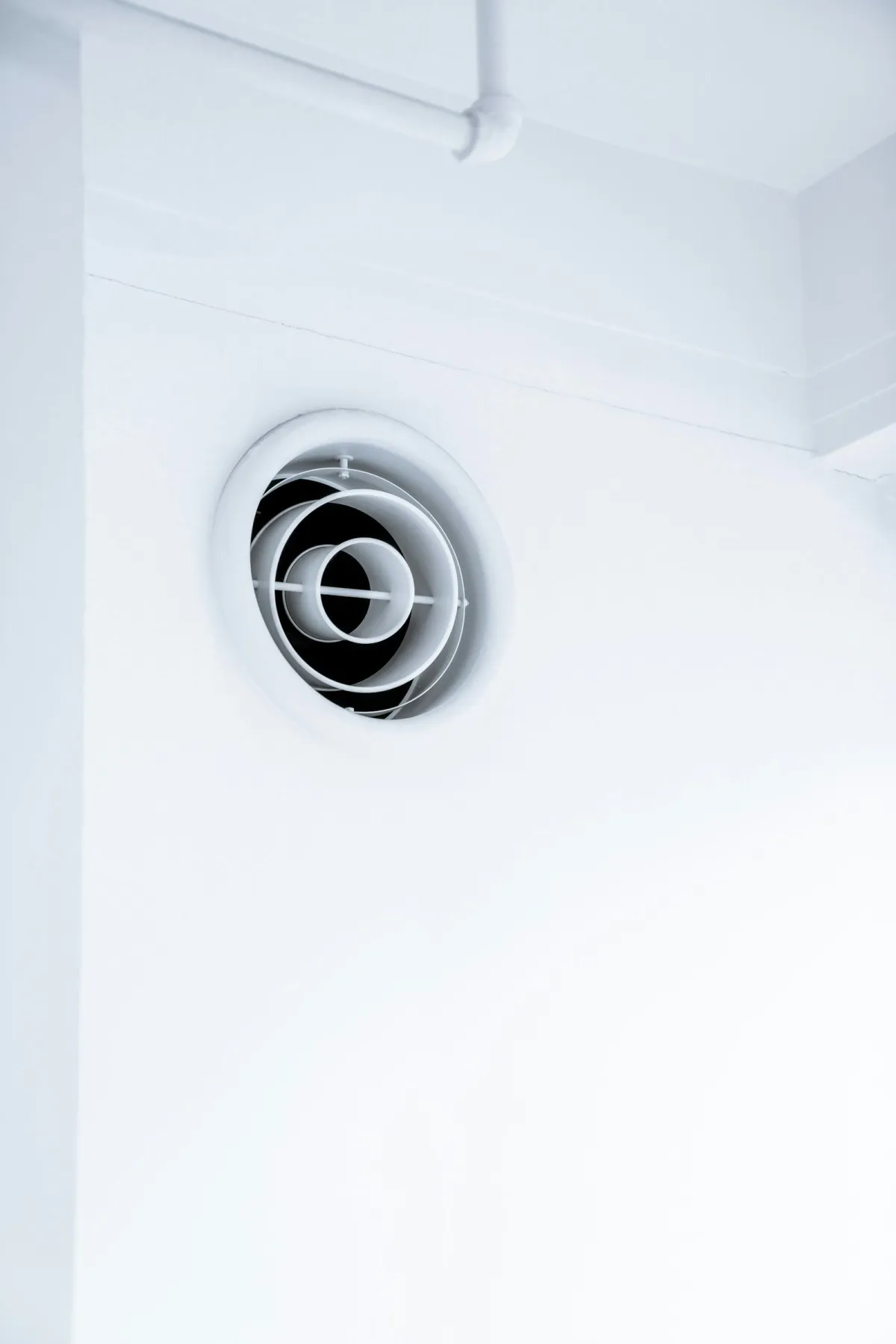
- Valves. Small round supply and extract valves in ceilings or walls, set during commissioning to give each room its design air flow.
- Outside terminals. One for intake and one for exhaust, kept apart so stale air is not drawn back in.
- Controls. A boost switch or humidity sensor for kitchens and bathrooms, and a reminder for filter changes.
MVHR, MEV or PIV: what is the difference?
- MVHR supplies and extracts air through ducts and recovers heat between the two streams.
- MEV (mechanical extract ventilation) only extracts, continuously, from kitchens and bathrooms. Fresh air comes in through trickle vents, and there is no heat recovery. A decentralised version (dMEV) uses a small continuous fan in each wet room.
- PIV (positive input ventilation) pushes filtered air into the house, usually from the loft, and lets it escape through gaps and vents. It is often used to tackle condensation in existing homes.
MVHR is not compulsory. The government's impact assessment for the Future Homes Standard, published on 24 March 2026, models new homes with decentralised mechanical extract ventilation, not MVHR. MVHR is the option that keeps the heat, and it pays its way in homes that are genuinely airtight.
Are MVHR systems worth it?
Yes, in an airtight, well-insulated home. There it gives steady, filtered fresh air in every room, controls humidity and keeps much of the heat that opening windows or extract fans would throw away. In a draughty house, outside air leaks in and out around the system, so little heat is recovered and a simpler extract system is usually the better value.
Can MVHR be retrofitted in an existing house?
Yes, but it works best as part of a wider renovation. The challenge is finding routes for the ducts: in a London terrace they often run through the loft, in floor voids during new flooring, and in boxing along ceilings. A retrofit makes most sense when the same project makes the house more airtight, for example with new windows, insulation or a new extension. Building work is the easiest moment of all, because ceilings and floors are open.
Can you turn off MVHR?
You can, but you should not. MVHR is designed to run all the time at a low speed. In an airtight home, switching it off stops the removal of moisture and pollutants, and condensation can follow within days. If you go away, leave it running on its normal setting; some units have a holiday mode.
Does MVHR provide heating, and can it cool a house?
No to both. MVHR recovers heat that would otherwise be lost with the stale air, but it does not create heat, so the home still needs a heating system. It is not air conditioning either. A summer bypass can bring in cooler night air without warming it through the heat exchanger, which helps on warm nights, but it will not cool a room the way an air conditioner does.
How much does MVHR cost to run?
It depends mostly on the fans: they run continuously, so their efficiency, the design of the ducts and your electricity tariff set the running cost. Short, smooth, correctly sized ducts let the fans work at low power. When you compare units, look at the specific fan power the manufacturer publishes, and remember the cost of replacement filters. For installation costs, see How much does MVHR cost in London?
How long do MVHR units last?
Many years, if the system is looked after. The heat exchanger has no moving parts; the fans and the controls are the parts that eventually wear. Check the manufacturer's warranty and expected service life before you choose a unit, and keep to the filter schedule, because clogged filters make the fans work harder.
How do you tell if MVHR is working?
Feel for a gentle, steady air flow at every valve, check that the boost responds when you cook or shower, and watch for condensation on windows, which should stay clear in normal use. Most units show a filter or fault warning. If rooms feel stuffy, ask for the air flows to be measured and compared with the commissioning record.
What are the disadvantages of MVHR?
- It needs an airtight home to deliver its benefits.
- The unit and ducts need space, and routing ducts in an existing house can be disruptive.
- Filters need regular cleaning or replacement.
- Two fans use electricity all the time.
- It has to be designed and commissioned properly, or it can be noisy or under-ventilate rooms.
What do the Building Regulations say?
Part F of the Building Regulations requires adequate ventilation, and Approved Document F, Volume 1 gives the guidance for homes. For mechanical systems it expects the installation to be commissioned and the air flow rates measured, and the homeowner to receive information on how to operate and maintain the system. Building work on an existing home, such as an extension, a loft conversion or new windows, should not make the ventilation of the rest of the house worse.
The government published new 2026 editions of Approved Documents F and L on 24 March 2026. They apply to most building work from 24 March 2027, with a transition period for work already submitted to building control, and they say that competent person schemes should be used when installing mechanical ventilation. Ducts that pass through fire-resisting floors and walls, for example between a loft conversion and the floor below, need to be fire-stopped.
How do you look after an MVHR system?
Leave it running, clean or replace the filters as often as the manufacturer recommends, keep the outside terminals clear, and do not adjust the room valves, because they were set during commissioning.
Frequently asked questions
Can I open the windows with MVHR?
Yes. You do not need to, because the system provides fresh air, but nothing stops you opening windows on a warm day.
Is MVHR noisy?
Not when it is designed and commissioned well. The unit sits away from bedrooms, the ducts are sized for low air speeds and silencers can be added.
Does MVHR need planning permission?
Rarely, because the system is inside the house. New terminals on the outside of a listed building, or on a block of flats, may need consent from the council or the freeholder, so check first.
Is MVHR worth it in a loft conversion or extension?
Often, because the new space is built well sealed and the ducts can go in while ceilings and floors are open. See MVHR and heat pumps in extensions and loft conversions.
How can GONT LTD help?
GONT LTD is a London building company that installs MVHR heat recovery ventilation in existing homes and as part of a house extension or loft conversion. We manage the whole process, from planning permission to building control sign-off, and work with an architect who can help with the design if your project needs it. We offer a free consultation and a free quote: call +44 7783 930505 (Monday to Friday, 9am to 5pm), email info@gont.co.uk, visit our showroom at 9 Royal Parade, Dawes Road, Fulham, or tell us about your project on our contact page.
Sources
- GOV.UK: Ventilation, Approved Document F
- GOV.UK: Conservation of fuel and power, Approved Document L
- legislation.gov.uk: Final stage impact assessment, Future Homes Standard, 24 March 2026
- UK Parliament: written statement on the Future Homes and Buildings Standards, 24 March 2026
- legislation.gov.uk: The Building Regulations etc. (Amendment) (England) Regulations 2026
General guidance for homes in England, checked against the sources above on 10 November 2026. Your building control body has the final say on the Building Regulations.